

The close of 2025 offers an opportunity to reflect on progress and sharpen our focus moving forward.

Now that 2025 has ended, at the start of this new year, we at Thrive After Domestic Violence (DV) pause to reflect on what it truly means to rebuild after harm and how far our community has come together to make that possible.
Abuse or sexual assault is harmful to the soul. Whether it is physical, sexual or non-physical abuse such as coercive control, recovering from the psychological and financial impact of abuse or rape can be a hard and lonely road. The negative impact can last decades or generations. Thrive After Domestic Violence’s goal is to help survivors break the cycle and ensure they and their children can thrive.
2025 reinforced a truth we see every day: safety is only the beginning. Survivors need stability. They need dignity. Survivors need real, tangible pathways to independence in order to move forward and rediscover their abilities to prosper in life.
In 2025, Thrive provided direct advocacy support that resulted in successful court outcomes for multiple survivors, including protective orders and the dismissal of a meritless lawsuits that threatened several survivor’s stability and credibility.
Jane H. Doe
Jane H was stalked by a man who had decided after several dates her 8-year-old son was his son despite they had just met weeks prior. He escalated quickly landing Jane H in the hospital clinging to life. A short temporary order was issued with the help of a well-known shelter. However once Jane left the shelter, the services to help her ended. There wasn’t any additional help with extending legal assistance to further protect her family. When the batterer was released from jail, the physical stalking resumed and quickly escalated again leading to a home invasion at gunpoint.
Thrive supported Jane H through filing an emergency protective order and guiding her through the process, working closely with law enforcement to assist with coordinating the arrest and execution of a warrant of a gun welding batterer. The court ultimately granted a 10-year protective order, providing long-term safety and legal stability to the victim and children. Criminal court is still pending. (Jane’s story is shared on the Thrive After DV homepage.)
Jane Y. Doe
Jane Y was referred to Thrive, after traditional resources in the area did not have the capacity to help her with an emergency protective order required by the hospital to bring her infant home. Thrive assisted Jane Y in filing an emergency protective order, coordinating with police to support the arrest of her abuser and court proceedings that resulted in strong temporary emergency protective order covering herself, her hospitalized child, and a friend. The order banned the abuser not only from their domicile, but also from the hospital, and visitation. It protected hermetically fragile child from any erroneous medical decisions that would harm the child from the abuser. Thrive also helped Jane, acting pro se, execute an emergency legal stay that protected her medically fragile infant child from an attempted custody removal by a non-biological father (the abuser), safeguarding the child’s immediate welfare and continuity of care.
Jane E. Doe
Thrive supported Jane after she was served with a lawsuit that falsely alleged interference with child custody (withholding) and the lawsuit failed to comply with the Texas Rules of Civil Procedure (TRCP). Thrive introduced this pro se mother to credible legal resources, online law libraries, and practical communication strategies to help her organize facts, evidence, and timelines.
Thrive worked with Jane to shift her courtroom communication away from trauma-driven emotional responses and toward fact-based, merit-driven legal arguments. This included applying marketing communication strategies to her written communications to the schools and court, practicing concise oral statements, and grounding her presentation of documented violations and verifiable facts.
On the day of the hearing, within 15 minutes, the case was dismissed.
The judge noted on the record that the brief was well written and clearly demonstrated multiple fabrications and procedural violations. The court further reinforced that perjury has consequences and has no place in family court.
This outcome is especially significant. Many survivors representing themselves in family court experience trauma-related shutdown, emotional flooding, or intimidation that undermines their credibility, regardless of the merits of their case. Thrive’s approach equips survivors with tools to regulate stress, organize evidence, and communicate clearly under pressure.
Empowerment Beyond the Courtroom
A key part of Thrive’s advocacy model is teaching survivors how to navigate systems, not just advocating for them within those systems. By combining legal literacy, structured communication strategies, and trauma-informed techniques such as cognitive-behavioral grounding, Thrive helps survivors remain present,
focused, and effective before and during when applying for services, advocating for their child's educational needs, speaking with law enforcement, talking to CPS, or court appointed guardian ad items involved in family court proceedings.
When survivors understand how to research the law, organize facts, and speak from evidence rather than emotion, the balance of power shifts.
Meeting Survivors at the Most Critical Moments
Throughout 2025, Thrive continued its core mission of survivor advocacy and stabilization. We supported individuals and families navigating some of the most complex and overwhelming moments of their lives from seeking protective orders, preparing for court,
understanding custody processes and gathering documentation required by systems that are not trauma-informed rather trauma inducing.
“In these moments, our role is not only practical but grounding.” said Doreen Hunter, Founder and Chair. “Survivors deserve support that honors their humanity while helping them understand their rights and options during deeply stressful legal and personal transitions.”
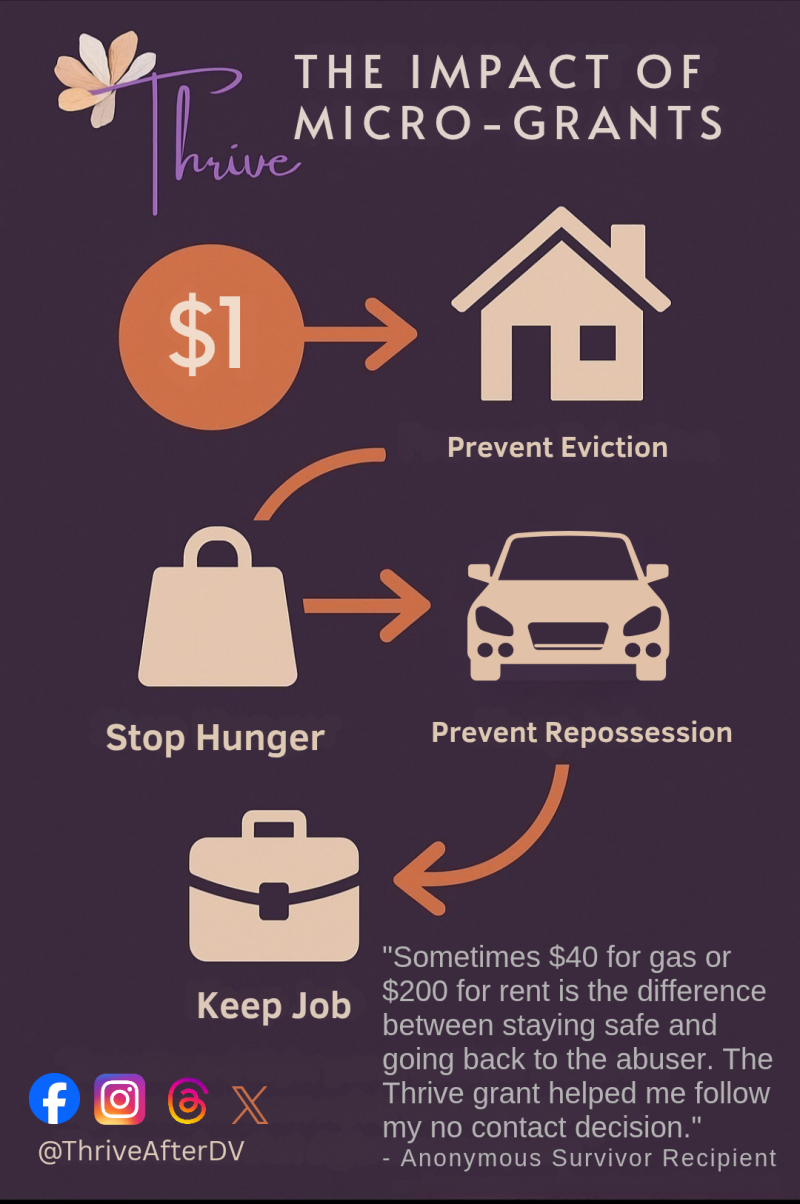
Our national Thrive Micro Grant Program continued to be a lifeline preventing crisis from snowballing into catastrophe. Small, timely grants helped survivors avoid eviction, avoid utilities shutoffs, prevent vehicle repossession, access food, and maintain employment during moments of acute financial strain.
Thrive micro grants are usually modest in size, with an average grant award under $75; however, their impact is profound. They prevent joblessness from a lack of transportation, help with school lunches and dinners. With our larger grants of $100 or more, the grants prevent homelessness, utility disconnections, preserve safety, and buy survivors something priceless: time to regroup and plan their next steps.
“My car broke down and was in the shop for repairs. Thrive helped me with Uber costs so that I could bring my children to school, take me to work and pick them up from school. I have no family here in Texas, their assistance was a big help.”
- Jane JR Doe
Measurable Outcomes Directly Impacting Survivors and Their Children
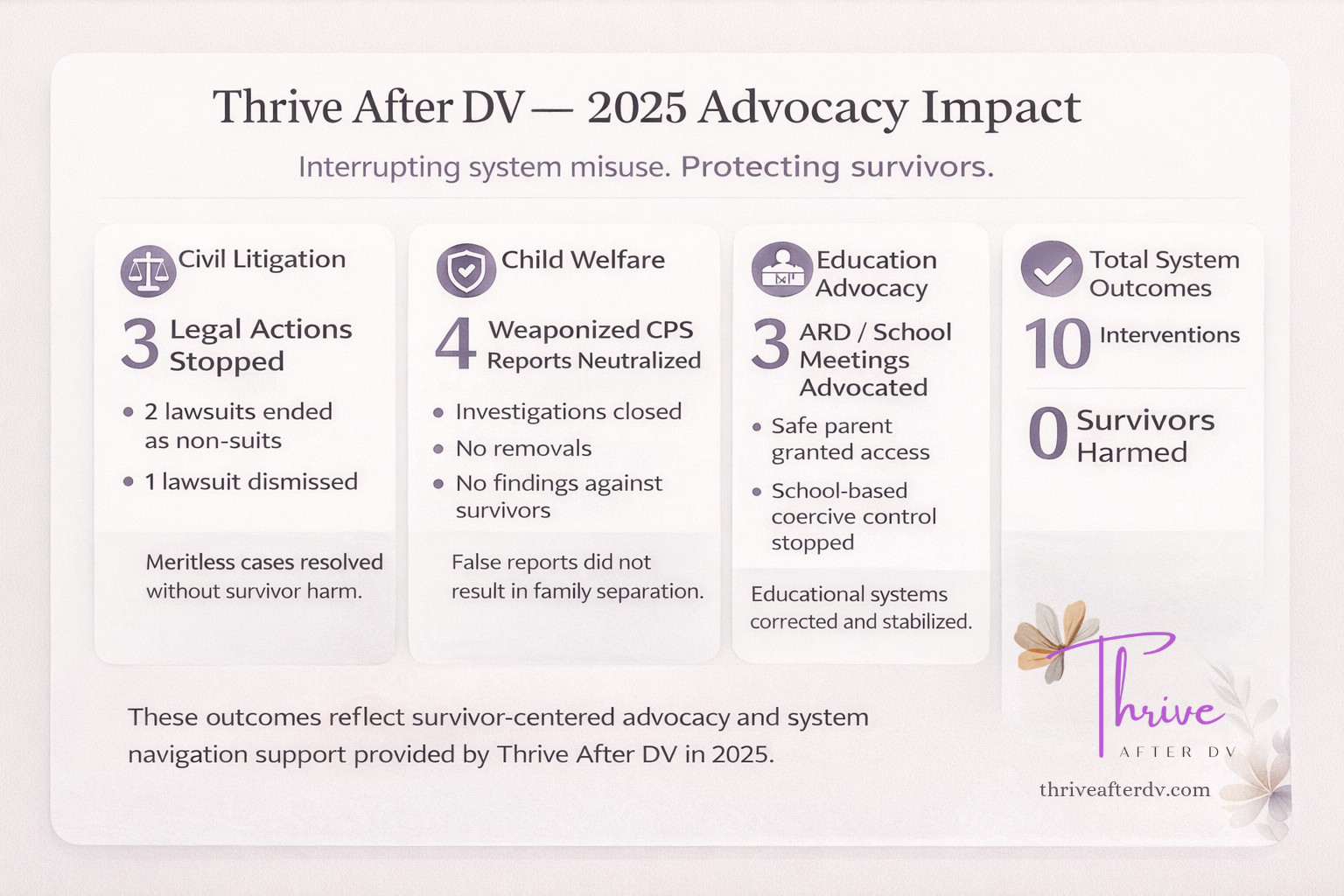
At Thrive, advocacy means action. In 2025, that action produced tangible legal results, crisis stabilization, and long-term empowerment for survivors navigating some of the most intimidating systems they will ever face.
“I'm a single mother. I acquired an older tiny house and renovated it myself. My ex-husband was angry that I made this major move in an attempt to improve my finances. A false report was made to CPS stating that the house was dirty, there was needles strewn all over the place, and strange men were coming in and out of the home. The men the CPS complaint referred to were the construction workers helping me with plumbing and electrical projects. Thrive After DV sat with me during the CPS interview as my DV Advocate and helped clear up some misconceptions. The CPS investigation against me was closed.”
- Jane EL Doe
“I asked Thrive to help me recover from childhood abuse. I was struggling with addiction and couch surfing. They got me into counseling and rehab. They helped me find scholarships, grants, and resources for my rehab program. I didn’t have a phone or transportation, so they picked me up and drove me almost two hours to San Antonio, TX from Austin, TX for rehab. They didn’t ask for anything. Actually, they fed me on the way. They stayed with me helping me fill out paperwork and helping me advocate my needs to the rehab staff. They really stood by me.”
- John ZP Doe
Home is Where the Heart Is
In a 2012 survey of 25 cities, 28% of Mayors cited domestic violence as a leading cause of homelessness among families with children.* Although Thrive provides micro grants to help with housing, another service program Thrive After DV offers its members, is the assistance in locating affordable housing. We work with survivors and finding affordable safe homes. Since many of the survivors have little to no property when their escaping their abuser, Thrive will host a community housewarming fundraiser to help ease the burden for the survivor to start over again. Our Community Housewarming Program also ensures survivors entering new housing with dignity providing beds, furniture, household essentials, and supplies so a new beginning did not start in empty rooms. With a large amount of furniture that was donated in 2024, Thrive was able to help families with dressers and beds so children are not sleeping on the floor in 2025. Several online wish lists were distributed as well helping survivors get exactly what they needed to start fresh. We are committed to our community housewarming program because the first night in a new place should feel like relief, not loss.
An unexpected benefit of the program is the survivor’s realization that people care. They see the furniture, towels and blankets and clothes, supplies for lunch for their children coming in and they regain their faith in humanity.
Looking Ahead with Gratitude and Resolve
Every protective order granted, every meritless case dismissed, every home stabilized represents more than a service delivered, it represents autonomy restored and harm interrupted.
As we move into the new year, Thrive After DV remains committed to results-driven advocacy, survivor-centered empowerment, and building systems that do not re-traumatize, instead restores clarity, safety, and self-determination.
Laying the Groundwork for Economic Independence
While immediate safety and stabilization remain central, this year also marked meaningful progress toward Thrive’s long-term vision: economic independence as a foundation for lasting survivor safety.
We are committed and are actively executing plans to advance programs to address affordable housing, income disparity, and food insecurity.
Economic stability is one of the strongest predictors of long-term safety for survivors. By investing in solutions in these areas, we are investing in futures that are self-directed, resilient, and rooted in community.
This year would not have been possible without the survivors who trusted us, the partners who believed in the work, and the community members who showed up through donations, collaboration, advocacy, and encouragement.
As we step into the new year, Thrive remains committed to building systems that do more than respond to crisis. We are building pathways toward safety, stability, independence, and hope. Summed up in one word: Freedom!
Thank you for standing with us. Together, we are turning advocacy into action, and action into justice.
Happy New Year!


*Source: The United States Conference of Mayors. (2012). A Status Report on Hunger and Homelessness in America’s Cities: A 25-City Survey (PDF). Washington, DC.