

By: Doreen Hunter
Edited By: M. Ruffin

I remember the moment a domestic violence specialist named the observable change in my toddler’s personality. It was something I had noticed but could not bring myself to say out loud. Hearing it spoken by someone trained to see it made the shift unmistakable. My toddler, once joyful, expressive, and developing a strong sense of self, had become chronically disassociated and almost unrecognizable. She was suddenly too agreeable, too pliable like a weed bending in the wind, no longer rooted in her own needs or preferences. The specialist saw what I was afraid to put words to: this was not temperament or organic character. It was a trauma response.
That recognition did not come from the guardian ad litem (GAL) assigned to her case as someone who knew her. No, the GAL did not seek to know her and did not witness her prior to the trauma. The insightful determination came from a domestic violence professional embedded in a program designed to understand how abuse reshapes children from the inside out. From that moment forward, I understood something with painful clarity: if I did not learn everything I could about domestic violence and its impact on children, the system would continue to fail to protect my child. The GAL and court were blind to the abuse. I had to educate and obtain help to correct the impact of her abuse so she would not become the worse of the statistics. That realization became a cornerstone of my advocacy not born from theory or ambition, but from the urgent need to understand how abuse hides in plain sight, and how easily children’s suffering is overlooked when systems fail to recognize it.
Turning A Child’s Environment Corrosive
When a child is living inside Child and Mother Sabotage (CAMS), silence does not emerge because the child lacks words. It emerges because the child learns, often very early, that speaking creates instability and entices dangerous responses. Abuse does not always arrive as overt cruelty, physically, or as a visible threat. More often, it takes shape as contradiction, quiet interference, and shifting expectations delivered by adults the child is expected to trust.
CAMS is not a disagreement between parents, nor is it a failure of communication. It is a sustained pattern of coercive control enacted through the child, where one parent undermines the child’s relationship with the other (most often the mother) by disrupting attachment, distorting reality, and recruiting systems to do the work indirectly. Over time, the child absorbs the cost of that sabotage, even when no one names it as such.
What Is CAMS & Why Children Are the Primary Targets
CAMS refers to a constellation of behaviors aligned with coercive control (Stark, 2007), in which an abusive parent preserves dominance after separation by destabilizing the child-mother bond. The child becomes the point of leverage, not because the child is weak, but because the child is relationally central.
The CAMS framework draws from the extensive empirical research of Prof. Joan S. Meier, whose multi-year analysis of U.S. custody decisions documents how coercive control and post-separation abuse are frequently mischaracterized in family courts, resulting in systematic harm to children. Meier is a professor of law and nationally recognized expert on domestic violence, child abuse, and custody litigation, whose work has been cited by courts, policymakers, and federal agencies.
These behaviors often include:
- Gaslighting and subtle reality distortion
- Loyalty binds that punish emotional closeness
- Interference with communication or contact
- Using the child as a messenger, monitor, or intermediary
- Erasing shared history and maternal identity
- Undermining routines, schooling, healthcare, or therapy
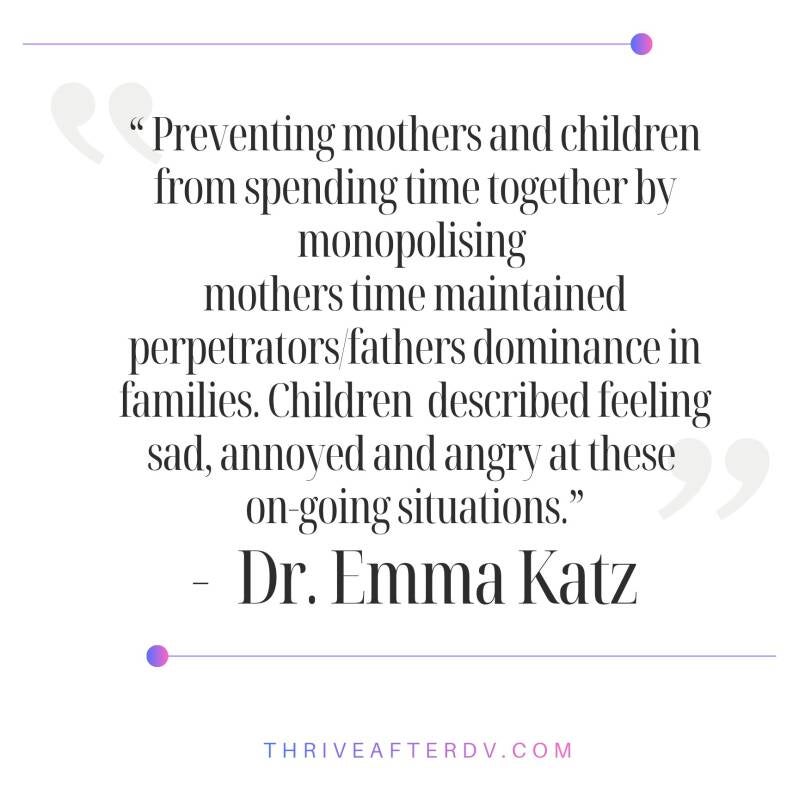
Research consistently identifies these patterns as forms of psychological maltreatment, associated with complex trauma responses in children (Dr. Emma Katz, 2016; Teicher & Samson, 2016). As Katz observes, “children living with coercive control experience ongoing patterns of fear, constraint, and domination that shape their everyday lives, relationships, and sense of self” (p. 166).
Neurodevelopmental research underscores the severity of this harm. Emotional maltreatment has been shown to exert a uniquely damaging impact on mental health, often rivaling or exceeding the effects of physical abuse, particularly when it is chronic and relational in nature (Teicher & Samson, 2016). In practical terms, this means that harm delivered through persistent emotional manipulation and instability can alter how a child’s brain organizes stress, attachment, and self-worth often with consequences that extend into adolescence and adulthood. As Teicher and Samson further note, emotional abuse and neglect are associated with depression, anxiety disorders, substance use, and an increased risk of suicidality.
Yet CAMS is frequently missed. Not because the harm is insignificant, but because it is filtered through systems that prioritize procedure over perception, and neutrality over safety.
Weaponizing Third Parties
Every case, I advocated, whether my own or another’s, the weaponization of third parties was always present. This strategy used by abusers is a prevalent part of CAMS.
Family Courts
Courts are often the first institutions drawn into the sabotage. When abuse is reframed as “conflict,” the response shifts toward compromise rather than protection. Empirical research shows that when abuse is raised in custody disputes, courts are less likely to credit those concerns and more likely to penalize the parent attempting to protect the child (Meier et al., 2019).
For children, this often means watching their fear be minimized, their protective parent discredited, and the truth treated as negotiable. Over time, this produces what trauma researchers describe as institutional betrayal a form of harm that occurs when institutions charged with protection fail to prevent, respond to, or actively compound abuse, thereby intensifying its psychological impact rather than resolving it (Freyd, 2014).
Educational Institutions
Schools are frequently drawn into CAMS through more subtle means. Access to information may be restricted. Parental involvement may be limited or reframed. Records may accumulate that quietly portray the mother as “difficult,” “unstable,” or peripheral. For children, these dynamics can produce deep confusion and shame. Especially when educators, acting in good faith, unknowingly reinforce a distorted narrative. Growing amount of research links such experiences to increased anxiety, depressive symptoms, and academic disruption (Felitti et al., 1998; Bowlby, 1988).
Healthcare and Mental Health Systems
In CAMS contexts, medical and mental health care are often subject to quiet manipulation. Appointments may be canceled or controlled. Clinicians may receive incomplete or distorted histories. Children may be punished (explicitly or implicitly) for what they disclose.
Gaslighting within therapeutic settings is particularly damaging. Research on psychological maltreatment and emotional abuse links these experiences to post-traumatic stress symptoms, dissociation, eating disorders, suicidal ideation, and long-term mistrust of care providers (Sweet, 2019; Teicher & Samson, 2016). When this harm occurs within healthcare or mental health systems, it is compounded by institutional betrayal, the failure of systems entrusted with care to recognize, prevent, or respond appropriately to abuse (Freyd, 2014). When spaces designed for healing become sites of distortion or punishment, children learn not only that their perceptions are unsafe to trust, but that care itself is conditional.
What This Abuse Does to Children
Across psychology, social work, and public health, the outcomes of CAMS-related abuse are strikingly consistent.
Children exposed to these patterns face increased risk of:
- Anxiety and depressive disorder
- Post-traumatic stress symptoms
- Eating disorders and self-harm
- Suicidal ideation
- Attachment insecurity and identity disruption
- Long-term relational difficulties that persist into adulthood
Adult follow-up studies of individuals exposed to parental sabotage describe enduring mental-health challenges and a diminished capacity for trust and intimacy (Baker & Ben Ami, 2011). The damage is not incidental. It follows a pattern.
The Centrality of the Mother–Child Bond
Decades of developmental research establish the primary caregiver bond—most often the mother–child relationship—as a foundational determinant of children’s psychological and physical health. Secure attachment is not merely an emotional preference; it is a biological and regulatory system through which children learn safety, self-regulation, and social trust (Bowlby, 1988; Schore, 2012). As Schore explains, “Early relational trauma alters the right brain’s regulatory functions, undermining a child’s capacity for stress modulation and affect regulation, and disrupting the fundamental systems through which secure attachment supports healthy development.”
Schore’s extensive work on how early bonding shapes emotion regulation and stress response systems is key. When this bond is consistently supported, it buffers stress, moderates fear responses, and promotes healthy brain and nervous system development. When it is disrupted or deliberately undermined, the consequences are profound and enduring. Jack P. Shonkoff, a pediatrician and expert on Child Health and development confirmed through decades of research:
“When a child is exposed to chronic, unbuffered adversity early in life, the stress response systems remain activated for prolonged periods, altering brain architecture and increasing risk for lifelong physical and mental health problems.”
Time and time again, since the 1950’s, research reveals that chronic disruption of the mother–child bond is associated with increased risk of depression, anxiety disorders, posttraumatic stress symptoms, and identity disturbance across childhood and adolescence (Lyons-Ruth et al., 2006; Schore, 2012). Children rely on the primary attachment figure to co-regulate distress; when access to that figure is restricted, distorted, or made emotionally unsafe, the child’s stress response remains chronically activated. Over time, this persistent activation contributes not only to psychological symptoms but to measurable physical health effects, including dysregulated cortisol patterns, immune suppression, gastrointestinal disorders, and increased vulnerability to chronic illness later in life (Shonkoff et al., 2012; Felitti et al., 1998).
Importantly, the harm does not arise simply from separation, but from relational betrayal and enforced instability. Studies on attachment trauma emphasize that children are most harmed when a trusted attachment relationship is rendered unreliable through manipulation, fear, or institutional interference (Lyons-Ruth & Jacobvitz, 2016). In CAMS contexts, where the child is pressured to distance from, distrust, or emotionally abandon the mother, the attachment system itself becomes a site of threat. The child is forced to adapt by suppressing needs, fragmenting loyalty, or dissociating from emotional truth. These adaptations may preserve short-term survival but undermine long-term mental and physical health.
From a public health perspective, the severing of the mother–child bond functions as an adverse childhood experience with cumulative impact. The ACEs literature demonstrates a dose-response relationship between early relational trauma and later outcomes, including heart disease, autoimmune disorders, substance dependence, and premature mortality (Felitti et al., 1998). When CAMS erodes the primary attachment relationship, it does not merely disrupt family dynamics; it alters the child’s developmental trajectory across systems of mind and body.
Compounding Internal Wounds
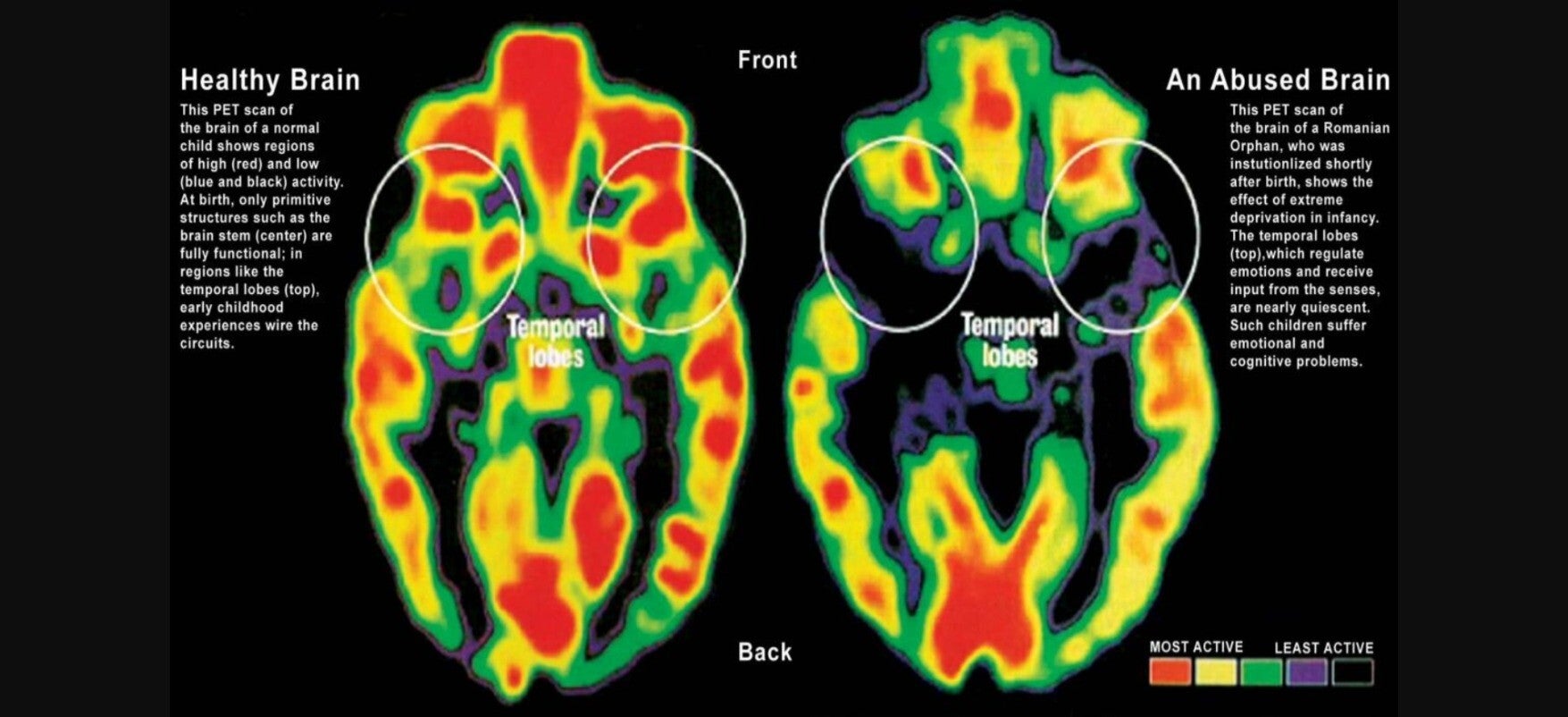
Neuroimaging research over the past two decades has demonstrated that chronic psychological maltreatment and emotional abuse are associated with measurable changes in the developing brain. Structural and functional MRI studies show that children exposed to ongoing relational threat such as fear, gaslighting, instability, and attachment sabotage, exhibit alterations in brain regions responsible for stress regulation, memory integration, and emotional control. These changes are not the result of isolated incidents, but of prolonged exposure to adverse relational environments, which is precisely the context in which CAMS operates (Teicher & Samson, 2016).
Specifically, neuroimaging studies have identified heightened reactivity in the amygdala, the brain’s threat-detection center, alongside reduced regulatory influence from the prefrontal cortex, which supports impulse control, reasoning, and emotional modulation. At the same time, alterations in the hippocampus, a structure essential for memory consolidation and contextual processing, have been observed in individuals exposed to emotional abuse and neglect. These patterns help explain why children subjected to chronic gaslighting and instability may struggle with anxiety, hypervigilance, emotional dysregulation, and difficulty trusting their own perceptions. Importantly, these findings are consistent across multiple studies and remain significant even when controlling for physical or sexual abuse, underscoring the independent neurobiological impact of emotional maltreatment (Teicher et al., 2012; Teicher & Samson, 2016).
What brain imaging makes clear is that this form of harm is biological as well as psychological. The developing brain adapts to survive environments marked by unpredictability and relational threat, prioritizing vigilance and appeasement over exploration and self-expression. While these adaptations may reduce immediate danger, they come at a developmental cost, shaping how children experience safety, attachment, and identity well into adulthood. Neuroimaging does not suggest irreversible damage, but it does confirm that emotional abuse and coercive environments leave detectable, lasting imprints on neural development. This is significant evidence that directly contradicts narratives minimizing this form of abuse as mere “conflict or high conflict” or interpersonal difficulty. Abuse and family violence is not high conflict.
What Systems Miss
Custody and access mediation systems often operate on assumptions that do not hold in the presence of coercive control: that power is shared, that conflict is mutual, and that cooperation reliably signals child well-being. Decades of research challenges each of these assumptions. When one parent uses coercive control, mediation without advocacy can function as an extension of the abuse itself (Katz, 2016; Stark, 2007). Children are safest when sabotage is recognized as abuse and not minimized as “family dynamics.”
Why Advocacy Matters
Advocacy interrupts CAMS by naming patterns children cannot safely articulate, restoring context erased through sabotage, and limiting the misuse of institutions that children depend on for safety.
Without advocacy, children learn that silence is rewarded and truth is destabilizing. With advocacy, children learn something different; that adults can be trustworthy, that reality has weight, and that protection is not conditional.
The abusive tactic of CAMS harms children not only through the actions of an abusive parent, but through what systems fail to recognize. When courts, schools, and healthcare institutions are weaponized children internalize fear as normal and confusion as truth.
This pattern is not anecdotal. Empirical research demonstrates that custody systems routinely fail to recognize abuse. In many cases, these systems penalize those who disclose it. In a large-scale study analyzing over 4,000 U.S. custody decisions, legal scholar Joan Meier found that when mothers alleged abuse, courts were less likely to credit those claims than when abuse was raised in other legal contexts. The risk increased sharply when the accused parent raised a counterclaim of “alienation.” In those cases, courts credited the alleged abuser over the protective parent in approximately 72% of decisions, and mothers lost custody at nearly twice the rate of cases where alienation was not alleged (Meier et al., 2019).
These outcomes have produced a well-documented chilling effect. Attorneys representing survivors routinely advise clients not to raise abuse concerns particularly psychological or coercive abuse because disclosure is associated with a higher likelihood of losing custody or being deemed uncooperative or unstable. For children, the consequence is stark: the adults most capable of naming the harm are discouraged from doing so, and silence becomes embedded not only as a coping strategy, but as a legal one.
The solution is not greater neutrality. It is informed advocacy grounded in trauma science and child safety. Children deserve systems capable of recognizing sabotage as abuse and advocates willing to insist that it not remain hidden.
Editor's Note:
This article is anchored in coercive control and psychological maltreatment research and explicitly rejects “parental alienation syndrome” (PAS/PA), a non-diagnostic construct derived from discredited theory and widely rejected by leading medical, legal, and human rights institutions. The framework used here centers child safety, trauma science, and documented patterns of coercive control.

Key Points in CAMs Research
Professor Joan Meier using scientific models, analyzed over collected over 15,000 cases of private custody cases in family court involving abuse or parental alienation claims from 2005-2014. The study was narrowed to 4,338 cases where more than 100 codes and sub-codes were designated. Meier presented her empirical finding on June 1, 2003, at the Oregon Family Law 9th Annual
Conference Overcoming Barriers to Justice.
- Gender Inequalities are Higher when pseudo-science of parental alienation is alleged in family court hearings:
• "When fathers accused mothers of alienation, they took custody
away in 44% of cases.
• When mothers accused fathers of alienation, they took custody
in only 28% of cases.
That is, mothers have twice the odds of losing custody compared
to fathers, when accused of alienation."
2. Court appointed third parties do not lesson the harmful outcomes of court decisions when the pseudo-science of parental alienation is alleged:
• "With a GAL in the case, mothers alleging abuse are 3-5 times more likely to lose custody, especially when alleging physical child abuse or mixed physical and sexual child abuse.
• "With an evaluator present, mothers alleging abuse are 2.5 – 6.5 times more likely to lose custody; the higher frequencies occur when mothers allege physical child abuse or mixed physical
and sexual child abuse."
Review Meier's full presentation deck:
U.S. CUSTODY OUTCOMES IN CASES INVOLVING ABUSE AND ALIENATION CLAIMS - Empirical Findings


Source: Dr. H. T, Chugani, Newsweek, Spring/Summer 1997 Special Edition: "Your Child: From Birth to Three." pp 30-31